✨ Fall Romance, Beautifully Styled — 10% OFF with SWAN10 — Ends Oct 5
Buy more pay less! Now offer wholesale pricing.
✨ Fall Romance, Beautifully Styled — 10% OFF with SWAN10 — Ends Oct 5
Buy more pay less! Now offer wholesale pricing.
✨ Fall Romance, Beautifully Styled — 10% OFF with SWAN10 — Ends Oct 5
Buy more pay less! Now offer wholesale pricing.
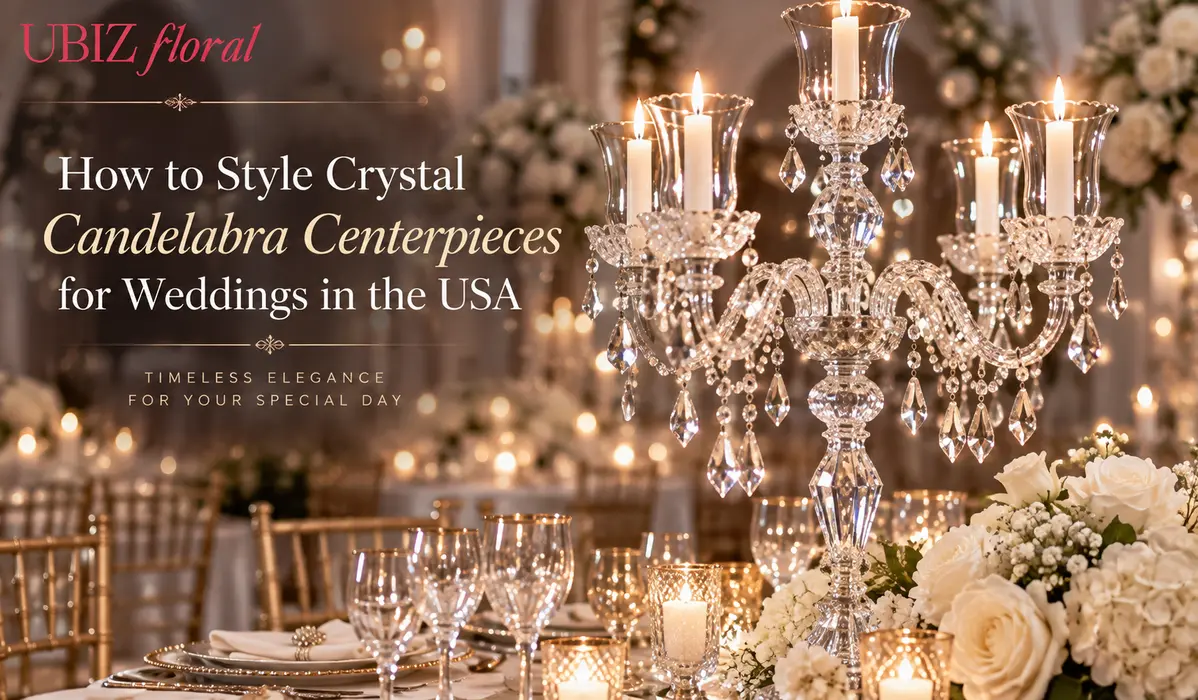
A crystal candelabra centerpiece works best when the crystal structure remains visible and the surrounding flowers, candles, and table decor support it rather than compete with it. The main styling decision is how much decoration to add around the candelabra while preserving its height, transparency, and reflective details.
For wedding receptions, crystal candelabras can be styled in several directions. White flowers create a softer formal look, black accents make the arrangement more modern, and glass hurricane cylinders create a cleaner candle display. The right approach depends on the candelabra's height, arm count, base shape, and the type of table being decorated.
UBIZfloral currently carries 25 crystal candelabra designs, including transparent, black, champagne, and gold options in round, rectangular, and square formats. Heights range from compact tabletop designs to models exceeding five feet.
You can compare the current options in the crystal candelabra collection before planning the floral and candle arrangement.
Start with the candelabra itself. Crystal pieces already contain visual detail through transparent surfaces, hanging beads, mirrored bases, curved arms, or glass cylinders, so adding too many decorative elements can make the arrangement feel crowded.
A useful approach is to choose one dominant styling element, such as flowers or candles, and let the remaining elements support it. For example, a floral-heavy centerpiece may need only simple white candles, while a detailed multi-arm crystal candelabra may need very little floral decoration at all.
Do not cover the entire stem, arms, or hanging details with flowers. Crystal candelabras depend on their structure being visible, especially when the design includes chandelier chains, mirrored surfaces, or multiple clear arms.
UBIZfloral's 36.6-inch 12-arm crystal candelabra, for example, includes 66 chandelier chains, a round mirror base, and multiple clear candle arms. A design like this already contains substantial decorative detail, so flowers are better used around the lower portion or surrounding table rather than wrapped around every arm.
A similar principle applies to taller models. The purpose of the flowers should be to frame the candelabra, not disguise it.
For most wedding tables, placing the main floral arrangement around the base or central stem creates a balanced result. This keeps the candles visible while adding enough floral volume to connect the centerpiece with the rest of the wedding decor.
Another option is to place smaller flower clusters around the table instead of attaching everything directly to the candelabra. This works especially well when the crystal design already contains multiple hanging elements or glass cylinders.
For a step-by-step explanation of attaching flowers and arranging greenery, use UBIZfloral's guide on how to decorate a candelabra centerpiece alongside this crystal-specific guide.
Crystal is visually neutral, so it can work with a wide range of wedding color palettes. The flowers should therefore be selected mainly according to the overall wedding style rather than trying to match the clear material itself.
White and ivory flowers create a light formal look, while blush, champagne, dusty rose, or burgundy add stronger color. Greenery can introduce contrast and soften the reflective surfaces without overwhelming them.
White roses and hydrangeas are a straightforward combination for crystal centerpieces because the light floral colors preserve the clear appearance of the candelabra.
Hydrangeas can create a fuller base arrangement with relatively few large flower heads, while roses can add more defined individual shapes. The two can also be combined with greenery to prevent the arrangement from becoming a solid block of white.
UBIZfloral carries artificial floral options including roses, hydrangeas, peonies, orchids, eucalyptus, and other event flowers. These can be viewed in the artificial flower collection.
Orchids work particularly well when the goal is a cleaner or more directional arrangement. Their longer stems and distinct flower shapes can create movement without requiring a large floral mass around the centerpiece.
A few orchid stems can be placed asymmetrically near the base or allowed to extend outward from a compact arrangement. This works especially well with clear crystal or black crystal candelabras where the frame itself is meant to remain prominent.
Greenery can help separate clear crystal from a white tablecloth, white flowers, or a bright reception space. A limited amount of eucalyptus-style foliage or trailing greenery can create enough contrast to define the centerpiece without changing its overall character.
Avoid adding greenery to every arm. A concentrated arrangement near the center or base usually looks more intentional and keeps the candle area visually open.
Crystal candelabras are not limited to one wedding aesthetic. The same material can support romantic, formal, modern, or dramatic settings depending on the candle style, floral palette, and finish.
Wedding Style | Candelabra Style | Floral Direction | Candle Style | Best Overall Effect |
Classic | Clear crystal | White roses and hydrangeas | White taper candles | Light and formal |
Romantic | Clear or champagne crystal | Blush, ivory and soft pink | Ivory tapers | Soft and warm |
Modern | Black crystal | White orchids or minimal flowers | Clear cylinders or LED | Strong contrast |
Glamorous | Multi-arm clear crystal | White flowers with minimal greenery | Multiple candles or glass cylinders | Detailed and reflective |
Moody | Black or dark-accent crystal | Burgundy, white and greenery | Warm candles | High contrast |
These combinations are not fixed rules. The venue, linens, tableware, lighting, and surrounding decor should determine whether the centerpiece needs more color, less decoration, or a stronger candle presence.
A clear crystal candelabra with white flowers is one of the easiest combinations to coordinate with a formal wedding table. The palette is restrained, which allows the candelabra's reflective details to remain visible.
A model such as UBIZfloral's 12-arm 36.6-inch crystal candelabra can be paired with a lower floral arrangement around the base while leaving the chandelier chains and candle arms exposed.
This approach works particularly well when the table also includes clear glassware, mirrored elements, or silver accents.
Black crystal creates a much stronger outline against light linens and white flowers. It can work well for modern, monochrome, evening, or black-and-white wedding themes.
UBIZfloral's 10-arm black crystal candelabra stands 39.4 inches tall, uses a round mirrored base, and includes ten glass hurricane cylinders. Because the black frame already creates strong contrast, a restrained floral arrangement usually works better than covering the structure with large quantities of flowers.
White roses, orchids, or a small amount of greenery can provide enough decoration while preserving the modern shape.
A tall centerpiece does not necessarily require a large floral arrangement. In many cases, a taller multi-arm candelabra already creates enough vertical presence to serve as the main visual feature of the table.
UBIZfloral also carries a 5.2-foot 13-head clear crystal candelabra designed for thirteen taper candles. A piece at that scale can work better with flowers placed around the base or elsewhere on the table rather than attached heavily throughout the frame.
This keeps the arrangement visually lighter and makes the height appear intentional rather than crowded.
Glass hurricane cylinders produce a cleaner vertical candle arrangement and can make a crystal centerpiece feel more structured. They are especially useful on designs where the cylinders themselves form part of the overall silhouette.
For example, UBIZfloral's 3-arm crystal candelabra stands 39.4 inches tall and includes 11.8-inch glass hurricane cylinders on a 7.1-inch round base.
Because the cylinders already create significant visual height, floral material should generally be kept below or outside the candle area.
Table shape affects how much visual weight the centerpiece can carry. A design that works on a long banquet table may feel oversized on a smaller round guest table, while a compact centerpiece may disappear visually on a large head table.
The most reliable approach is to evaluate the complete setup with flowers, candles, table settings, and chairs in place.
Round tables normally place the candelabra at the central point, so the arrangement is viewed from every direction. Symmetry can work well here, particularly with round-based crystal designs.
Keep the lower floral arrangement reasonably compact so it does not consume too much table surface. A tall narrow structure with flowers concentrated close to the base can often preserve more usable space than a wide low arrangement.
For more detailed guidance on height, footprint, and arm count, see the candelabra size guide.
Long tables allow crystal candelabras to be repeated at intervals or combined with smaller floral arrangements, candles, and greenery along the table.
A rectangular-base candelabra can also follow the shape of the table. UBIZfloral's crystal range includes both rectangular and round designs, so table shape can be considered alongside color and height rather than treating all crystal candelabras as interchangeable.
Leave enough space between large centerpieces so the repeated pattern does not become visually dense.
Sweetheart and head tables can support stronger statement pieces because they often act as focal areas within the reception.
A tall crystal candelabra can help frame the table, but it should not block the couple, wedding party, signage, or backdrop in photographs. Test the centerpiece from the main photography angles as well as from the guests' perspective.
Larger multi-arm designs are useful when the centerpiece needs to remain visually noticeable from across the room, but proportion still matters more than simply choosing the tallest option available.
The candle style should match the candle holder built into the candelabra. Some designs support taper candles, while others use glass hurricane cylinders or integrated LED lighting.
Never assume that a candle fits because its general shape looks correct. Check the product specification for supported candle dimensions before purchasing candles in quantity.
Taper candles create the traditional multi-arm candelabra appearance. They work particularly well with curved clear arms and chandelier-style designs because they continue the vertical lines of the centerpiece.
Choose a candle color that supports the rest of the table. White and ivory are easy to coordinate, while colored candles can be used when they repeat an existing wedding color rather than introducing a new one.
Hurricane cylinders add a visible glass layer around the candle area. On crystal candelabras, this can make the centerpiece appear more architectural because the vertical glass shapes become part of the design.
Check the cylinder height and diameter before replacing any included glass. Product-specific measurements matter because different UBIZfloral candelabras use different cylinder dimensions.
Flameless candles may be useful where an event venue restricts open flames or where flowers would otherwise sit too close to the candle positions.
The U.S. Fire Administration recommends considering battery-operated flameless candles. When lit candles are used, it advises using stable holders and keeping candles at least 12 inches from anything that can burn.
You can review the full U.S. Fire Administration candle safety guidance before planning a wedding centerpiece that uses open flames.
Crystal candelabras can become heavy once they are fully assembled, particularly larger multi-arm designs. Flowers, candle cylinders, and other decorations can also change the balance of the finished centerpiece.
Check the product's weight, base dimensions, and assembly instructions before adding decoration. For example, the 12-arm 36.6-inch UBIZfloral model weighs 26.5 pounds and requires assembly, while the 5.2-foot 13-head model weighs 38 pounds.
Do not attach large floral arrangements high on one side without testing whether the extra weight changes the stability of the centerpiece. When using asymmetrical flowers, keep the underlying support secure and check the finished piece on the actual table surface before the event.
The most common styling problem is adding too many elements simply because the candelabra has available space. A crystal centerpiece can lose its visual clarity when every arm, stem, and base area is covered with flowers, ribbon, greenery, beads, and additional accessories.
Avoid:
The U.S. Consumer Product Safety Commission lists voluntary ASTM standards addressing candle fire safety and candle accessories, including ASTM F2417 and ASTM F2601. Its guidance can be reviewed through the CPSC candle and candle accessories page.
Start with the table rather than the decoration. Measure the available surface area, decide how much height the reception layout can support, and then compare base shape, arm count, candle format, and overall weight.
A three-arm crystal candelabra with hurricane cylinders creates a much cleaner and lighter visual profile than a twelve-arm chandelier-style piece, even when both are relatively tall. Similarly, a black crystal design produces much stronger visual contrast than a transparent model, even when their dimensions are similar.
Once the correct candelabra is chosen, use flowers and candles to reinforce its shape instead of hiding it. That approach usually produces a cleaner wedding table and makes the crystal structure itself part of the overall design.
You can compare current colors, heights, base shapes, and arm configurations in UBIZfloral's crystal candelabra collection. For other materials and styles, browse the broader wedding candelabra collection.
Keep the main crystal structure visible, then add one primary decorative element such as flowers or candles. Flowers usually work best around the base or central stem, while the candle arms and hanging crystal details remain relatively open.
White roses, hydrangeas, peonies, orchids, and greenery all work well with clear crystal. Blush, champagne, burgundy, and dusty rose can also be used when those colors already appear elsewhere in the wedding palette.
Yes, provided the base and arm spread fit the available table space. Round-based designs can work particularly well because they can be viewed evenly from multiple seating positions.
Use the candle type and dimensions specified for the individual candelabra. Depending on the design, this may include taper candles, candles placed inside hurricane cylinders, or integrated LED lighting.


 White
White
 Pink
Pink
 Champagne
 Gold
Gold
 Ivory
Ivory
 Silver & Grey
 Black
Black
 Coral
Coral
 Fuchsia / Hot pink
 Blush
Blush
 Dusty Rose
 Red
Red
 Burgundy
 Apple Red
 Orange
 Peach
Peach
 Burnt Orange
 Terracotta
 Royal Blue
 Navy Blue
 Aqua Blue
 Baby Blue
 Turquoise
 Chocolate Brown
 Beige
Beige
 Yellow
 Cream
Cream
 Purple
 Rose Red
 Light Purple
 Violet Red
 Lavender
 Green
Green
 Apple Green
 Grayish Green
 Natural Green