🍁 Embrace the Fall Wedding Season — Take 10% OFF Event Décor with CHAR10 — Ends Sept 21
Buy more pay less! Now offer wholesale pricing.
🍁 Embrace the Fall Wedding Season — Take 10% OFF Event Décor with CHAR10 — Ends Sept 21
Buy more pay less! Now offer wholesale pricing.
🍁 Embrace the Fall Wedding Season — Take 10% OFF Event Décor with CHAR10 — Ends Sept 21
Buy more pay less! Now offer wholesale pricing.
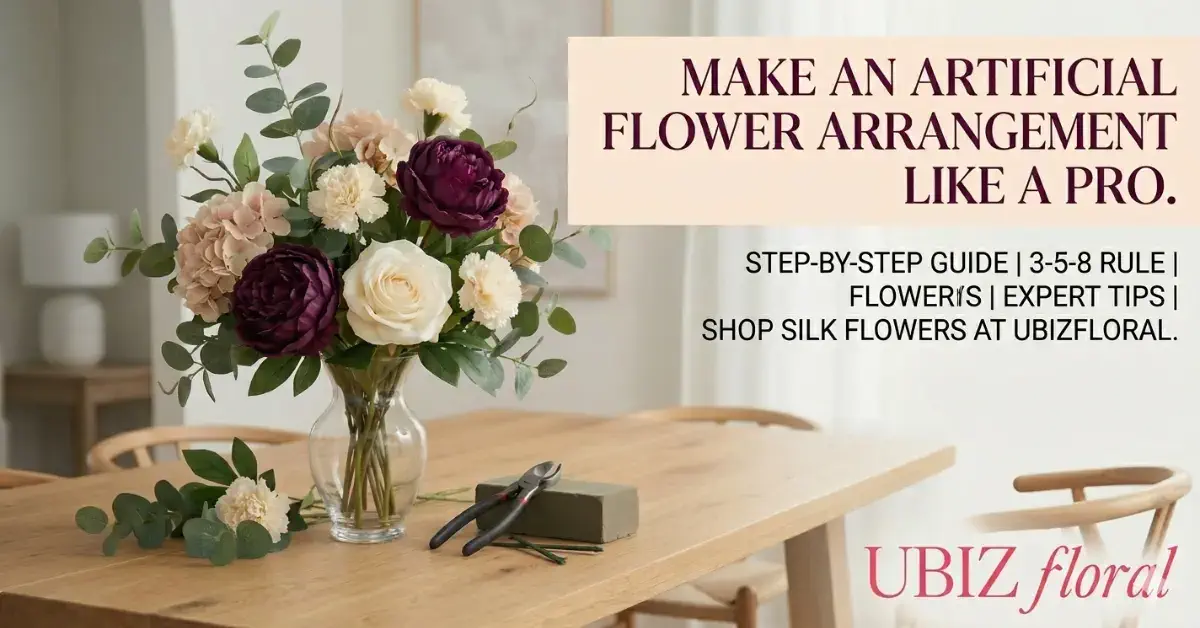
Whether you are planning a wedding, styling your dining table, or just want lasting beauty at home, learning how to make an artificial flower arrangement is one of the best skills you can pick up. The answer is simple: start with good flowers, use the right structure, and layer from big to small. At Ubizfloral, you will find a wide range of silk flowers built for exactly this kind of DIY work.
Getting the right tools ready saves you a lot of time. You do not need to be a pro to do this well. Just gather these items before you begin.
Here is the full process, from choosing your flowers to putting the final touches in place.
Choose a mix of flower types, not just one. A good rule is to pick one or two large blooms (like peonies or roses), one or two medium fillers (like hydrangeas or carnations), and some greenery or small sprigs.
Stick to two or three colors max. Too many shades make the arrangement look busy. Deep tones like plum or burgundy feel rich and bold. Soft tones like blush and ivory feel romantic and clean.
At Ubizfloral, the silk peonies and artificial roses are two of the most popular picks for this step. Both come in bulk packs and look very close to real flowers.
Place your dry foam inside the vase. Cut it to fit snugly. If you are using a clear glass vase, cover the foam with river stones, pebbles, or craft sand so it does not show.
If you do not have foam, crumple packing paper tightly into the vase until it holds stems with some resistance.
The general rule is that your arrangement should stand 1.5 to 2 times the height of your vase. So if your vase is 8 inches tall, your flowers should reach about 12 to 16 inches above it.
Cut your tallest stem first. Place it in the center or slightly off-center. This becomes your anchor point.
Greenery goes in before the flowers. Add leaves and foliage around the edges and between where you plan to place blooms. This fills gaps and gives the arrangement a natural look.
Ubizfloral carries flower leaves and bushes that work great for this step.
These are your largest blooms. Place them at different heights, not all at the same level. Work in odd numbers. Three peonies look more natural than four. Five roses have more balance than six.
Push stems into the foam at slight angles. Straight stems look stiff and fake.
Fillers are smaller flowers and softer shapes. They go in between the focal flowers. Artificial hydrangeas work perfectly here because their round heads fill space without competing with the main blooms.
This is the step most beginners skip. Bend each stem slightly so it curves. Twist some petals open a bit more. Fan out leaves so they face different ways. This is what makes an arrangement look real rather than fake.
As legendary British florist Constance Spry, who even arranged flowers for Queen Elizabeth II's coronation, always believed: the character of each material matters. Every stem should feel like it found its own natural place, not like it was forced in.
Step back and look at the whole piece. Fill any gaps you see. Make sure the arrangement looks full from all sides, not just the front. Rotate it and check.
This is one of the most useful rules in floral design, and almost no beginner article talks about it clearly.
The rule refers to using flowers in odd groupings of 3, 5, or 8. Odd numbers look more natural to the human eye. An arrangement with 3 focal flowers, 5 filler stems, and 8 greenery sprigs will feel balanced without looking too planned or rigid.
The same rule applies to heights. Three different height levels (low, mid, high) give depth to any arrangement. Using just one or two height levels makes things look flat.
Number | Best Used For |
3 | Focal blooms (peonies, roses) |
5 | Filler flowers (hydrangeas, carnations) |
8 | Greenery, small sprigs, leaves |
Tall arrangements work well on console tables, mantels, and as ceremony backdrop pieces. They need a stable base above all else.
Use a tall, heavy vase or a wide-bottom urn. Pack it firmly with foam or heavy filler like sand or stones. Add long branches or tall stems first, like cherry blossoms or wisteria. Ubizfloral carries cherry blossoms and wisteria stems that are ideal for tall builds.
Keep the tallest point directly above the center of the vase so it does not tip. Work down and outward from that point, adding progressively shorter stems as you move toward the rim.
For a top table or wedding arrangement, use a base riser or pedestal stand to add even more height without making the flowers overly long. Ubizfloral has centerpiece stands and risers in their tabletop and centerpiece section that pair well with silk flowers.
Different spaces need different styles. Here is a quick breakdown:
Dining Table: Keep things low so guests can see each other across the table. A round, compact arrangement in a wide bowl or a runner of small vases works best. Ivory, blush, or plum artificial flower arrangements are very popular for dining tables right now.
Mantel or Shelf: Go tall and dramatic. Use a vase with height and let stems reach upward. Cherry blossoms and hydrangeas work beautifully here.
Entryway: A large artificial flower arrangement in a floor vase makes a strong first impression. Mix greenery with big blooms and let some vines drape down naturally.
Wedding Centerpieces: Keep color and height consistent across all tables. Use one focal bloom type and one filler type across all your centerpieces so the room feels cohesive.
Glass Vase: Use craft water or clear silicone gel at the base. This mimics the look of real water and hides the foam underneath. It is one of the most effective tricks for arrangements in clear vases.
One topic that competitors rarely mention: light placement matters with artificial flowers. Silk flowers can fade if placed in direct sunlight for long periods. Place your arrangement in a spot with indirect light for the best long-term look.
Most people get these wrong on their first try. Knowing about them in advance saves you from starting over.
Now that you know the full process, the best next step is to get your flowers ready. Ubizfloral, founded in Sacramento, California, has been a trusted name in silk flowers and event decor since 2016. Their collection covers everything from single stems to bulk packs of peonies, hydrangeas, roses, and more.
Whether you are building a small dining table piece or a large wedding centerpiece, their silk flower range has the variety and quality to make your arrangement look real. Plus, with wholesale pricing, you can order in bulk without the stress of a tight budget.
Browse their top-selling stems, pick your color palette, and get started. A great artificial flower arrangement is closer than you think.
It means using flowers in odd numbers -- 3 focal blooms, 5 fillers, and 8 greenery pieces. Odd numbers look more natural and balanced to the eye than even numbers.
Not if you choose quality ones. High-quality silk flowers are nearly impossible to tell apart from fresh ones at a glance. The key is to avoid plastic-looking, shiny flowers and instead go for silk or real-touch materials with natural color gradients.
Silk and real-touch peonies, hydrangeas, and roses are consistently rated as the most lifelike. Look for flowers with layered petals, subtle color shifts, and soft textures. Ubizfloral's silk peonies and hydrangeas are strong examples of this.
Start with structure (greenery and base), add focal flowers, then fill with smaller blooms. Always work in odd numbers and vary stem heights.
Bend each stem slightly so it does not sit perfectly straight. Use foam or packing paper to hold stems at angles. Add greenery first to create a natural base, then place flowers at different heights.
Choose 3 to 5 stems of one main flower and a few greenery sprigs. Secure foam in your vase. Place the tallest stem first, then add others at slightly shorter heights around it. Fill gaps with leaves. Bend stems for a natural look.


 White
White
 Pink
Pink
 Champagne
 Gold
Gold
 Ivory
Ivory
 Silver & Grey
 Black
Black
 Coral
Coral
 Fuchsia / Hot pink
 Blush
Blush
 Dusty Rose
 Red
Red
 Burgundy
 Apple Red
 Orange
 Peach
Peach
 Burnt Orange
 Terracotta
 Royal Blue
 Navy Blue
 Aqua Blue
 Baby Blue
 Turquoise
 Chocolate Brown
 Beige
Beige
 Yellow
 Cream
Cream
 Purple
 Rose Red
 Light Purple
 Violet Red
 Lavender
 Green
Green
 Apple Green
 Grayish Green
 Natural Green