✨ Fall Romance, Beautifully Styled — 10% OFF with SWAN10 — Ends Oct 5
Buy more pay less! Now offer wholesale pricing.
✨ Fall Romance, Beautifully Styled — 10% OFF with SWAN10 — Ends Oct 5
Buy more pay less! Now offer wholesale pricing.
✨ Fall Romance, Beautifully Styled — 10% OFF with SWAN10 — Ends Oct 5
Buy more pay less! Now offer wholesale pricing.
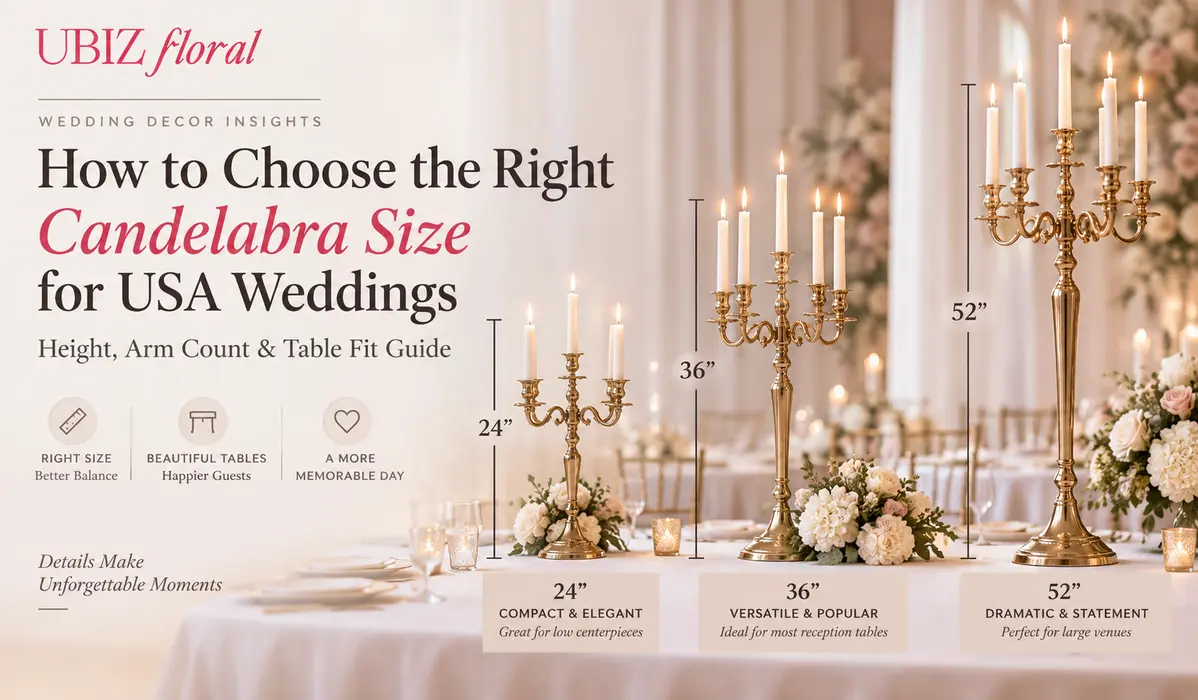
The right candelabra size depends on the table, available surface space, number of candle arms, base dimensions, and the finished height after candles and decorations are added. A centerpiece can look appropriately proportioned in product photos but feel too wide, too low, or too visually dense once it is placed between full wedding place settings.
For most receptions, height should not be considered by itself. A tall candelabra with a narrow base can occupy less useful table space than a shorter design with a wide frame, while adding hurricane cylinders or flowers can significantly change the proportions of either option.
UBIZfloral's wedding candelabra collection includes compact tabletop designs and larger multi-arm centerpieces, which makes the relationship between height, arm count, and footprint particularly important when choosing a piece for a reception table.
This guide explains how to compare those measurements and choose a candelabra that fits the table rather than selecting one based only on its listed height.
A candelabra has several dimensions that affect how it will function as a wedding centerpiece. Overall height is the most obvious measurement, but the base size and horizontal spread often determine whether the piece actually fits comfortably among plates, glasses, table numbers, floral accents, and serving items.
Before choosing a centerpiece, check the overall height, base footprint, arm spread, and final height after candles or cylinders are installed. If flowers will be attached directly to the candelabra, their width and placement should also be considered.
The listed product height normally describes the main candelabra structure. Depending on the design, glass cylinders, candles, lampshades, floral arrangements, or decorative elements can make the finished centerpiece appear taller or fuller.
For example, UBIZfloral's 31.5-inch five-arm crystal candelabra has a 5.9-inch round mirror base and 7.9-inch glass hurricane cylinders. Those measurements provide much more useful planning information than the 31.5-inch height alone.
The same principle applies to any candelabra. Measure or review the finished configuration rather than assuming the advertised height tells you how much physical and visual space the centerpiece will use.
The base determines how much tabletop space becomes unavailable for other items. This is particularly important on guest tables where plates, glasses, silverware, table numbers, favors, menus, and shared serving pieces may already take up much of the usable surface.
A narrow base can make a relatively tall centerpiece practical on a crowded table. In contrast, a long rectangular base may work better on a banquet table where its shape follows the length of the table rather than occupying a large circular area in the center.
Arm count does not reliably tell you the footprint. Two ten-arm candelabras can have very different base shapes and widths, so exact product dimensions should always be checked before deciding how many will fit into the reception layout.
A candelabra should be evaluated as a complete centerpiece, not as an empty frame. Hurricane cylinders add vertical volume, floral arrangements add width, and hanging decorations can increase visual density even when they do not use additional table surface.
UBIZfloral's 4-foot ten-arm crystal candelabra stands 47.2 inches tall, uses a 13.8-inch round mirror base, and includes 13.8-inch glass hurricane cylinders. It therefore creates a different table presence from a shorter five-arm design even before flowers are introduced.
When comparing models, picture the complete arrangement with candles, glass, flowers, greenery, and nearby place settings. That is the version guests will actually see.
Table shape changes how a centerpiece occupies space. A round table concentrates decoration in one central area, while a long table allows candelabras, candles, and flowers to be distributed across its length.
Sweetheart and head tables have different requirements again because they are often viewed mainly from the front and appear prominently in photographs. This means the same candelabra can work well in one part of a reception and feel poorly proportioned in another.
A round table usually places one primary centerpiece in the middle. Because guests surround the arrangement from several directions, both the footprint and the upper width need to leave enough room for table settings and comfortable conversation.
A relatively narrow base can make a taller centerpiece easier to accommodate. The 31.5-inch five-arm UBIZfloral example uses a 5.9-inch round base, giving it vertical presence without consuming a large central footprint.
That does not mean 31.5 inches is automatically the correct height for every round table. Table diameter, chair height, floral volume, candle position, and the width of the upper arms still need to be checked as a complete setup.
Long tables allow centerpieces to be arranged in a sequence rather than relying on one large focal point. Narrow candelabras can be repeated at intervals, or one longer centerpiece can be combined with smaller candles and flowers running along the table.
The most important measurement here may be the width across the table, rather than the total length of the centerpiece. A design that takes up too much table width can interfere with place settings on both sides even if there is plenty of unused space along the table's length.
When multiple candelabras will be used, also account for the distance between them. Repeated tall centerpieces placed too closely together can make the tablescape appear crowded even when each individual base technically fits.
Sweetheart and head tables often allow a more dramatic centerpiece because the arrangement can function as part of the reception backdrop. Tall crystal or multi-arm designs can work well when there is enough vertical space and the centerpiece does not cover important sightlines.
The main concern is composition. A centerpiece should not obscure the couple in photographs, interfere with signage, compete with an arch or flower wall, or leave too little room for dining.
UBIZfloral's existing wedding candelabra centerpiece guide covers materials and general centerpiece configurations in more detail. The sizing article should remain focused on dimensions, table fit, and proportion rather than repeating the broader styling information already covered there.
Arm count changes the visual weight of a candelabra as well as the number of candle positions. A larger number of arms can create more horizontal spread and make the centerpiece appear fuller, even when its base dimensions remain relatively compact.
For this reason, shoppers should compare height and arm count together rather than treating either measurement as a complete description of size.
Five-arm candelabras generally create a less dense candle arrangement than larger ten-arm or thirteen-arm models. They can work well where a clear candelabra silhouette is wanted without making the upper section of the centerpiece visually heavy.
The UBIZfloral crystal collection currently includes five-arm designs at several different heights, including 31.5-inch and 33.5-inch options. This demonstrates why arm count should not be used as a substitute for height.
A five-arm centerpiece may be relatively compact or quite tall. Check the actual dimensions and base rather than assuming every five-arm design fits the same type of table.
Ten-arm candelabras create a stronger candle display and generally have more visual presence. They can work particularly well for larger reception tables, head tables, statement centerpieces, or layouts where the candelabra is intended to provide much of the vertical decoration.
A 47.2-inch ten-arm crystal model from UBIZfloral uses a 13.8-inch round base and weighs nearly 30 pounds before additional decorations are added. That combination of height, weight, arm count, and base size matters much more for setup planning than the phrase "ten-arm candelabra" by itself.
If several large units will be used across a venue, also think about assembly, transport, table stability, and storage. Those practical considerations become more important as centerpiece size increases.
A thirteen-arm design creates a substantial visual focal point and can be appropriate where the centerpiece is intended to stand out from across the room. It may suit large formal tables, sweetheart tables, stage-adjacent settings, or other areas where stronger vertical decoration is wanted.
UBIZfloral's 44-inch thirteen-arm crystal candelabra uses an 8-by-8-inch square base and weighs 35 pounds. The relatively compact base shows why physical footprint and total weight need to be considered separately.
Large candelabras should be assembled on a stable surface and tested before additional floral or decorative weight is attached.
There is no universal candelabra height that is correct for every wedding table. The useful question is whether the completed centerpiece allows the table to function properly while maintaining the intended visual scale.
Guest visibility is especially important. A centerpiece can be tall without blocking conversation if most of its visual mass sits above seated eye level, while a shorter but very wide floral arrangement can create more obstruction.
This is why fixed internet rules about centerpiece height should be treated cautiously. The actual result depends on table dimensions, chair height, arm position, floral volume, candles, cylinders, and the angle from which guests view the centerpiece.
Before finalizing the size, set up the candelabra with the same elements that will be used at the reception. Add the candles or cylinders, attach the planned flowers, arrange the table settings, and sit in several guest positions around the table.
Check whether people seated opposite one another can see comfortably and whether the arrangement feels balanced with the room. A multi-arm candelabra may appear open from one angle but much denser from another, so checking only the front view is not enough.
This test is more reliable than choosing a centerpiece solely because its listed height falls within a generic online recommendation.
The following framework is more useful than assigning one mandatory height to every table type.
Wedding Table | Measurements to Prioritize | What to Test Before the Event |
Round guest table | Base diameter, arm spread, decorated height | Place-setting space and sightlines from several seats |
Long rectangular table | Base width, length, arm spread | Space between guests and spacing between multiple centerpieces |
Sweetheart table | Total height and width | Couple visibility, photographs and backdrop balance |
Head table | Width, height and number of units | Sightlines and visual consistency across the full table |
Display or cake-area table | Height, base stability and surrounding clearance | Interaction with signage, cake, flowers and background decor |
The objective is not to choose the largest centerpiece that physically fits. The correct size leaves enough space for the table's practical use while keeping the proportions appropriate for the room and surrounding decor.
If real candles will be used, spacing becomes a safety consideration as well as a design choice. Flowers, greenery, fabric, ribbons, paper decorations, and similar materials should not be positioned simply according to appearance.
The U.S. Fire Administration's candle safety guidance recommends using stable candle holders and keeping burning candles at least 12 inches away from anything that can burn. It also recommends considering battery-operated flameless candles.
This should be considered when adding flowers to a large multi-arm centerpiece. A floral arrangement that looks appropriately proportioned while the candelabra is empty may become too close to the candle positions once the complete design is assembled.
The U.S. Consumer Product Safety Commission also identifies voluntary ASTM standards addressing fire safety for candles and candle accessories. Its candles and candle accessories guidance lists standards including ASTM F2417 for candle fire safety and ASTM F2601 for candle accessories.
Individual wedding venues may have additional requirements for open flames, so confirm the venue's rules before designing around real candles.
The best candelabra size is the one that works with the complete wedding table, not simply the model with the most height or candle arms.
Start with the available tabletop space, then compare the base dimensions and horizontal spread. After that, account for the final height created by candles, hurricane cylinders, flowers, or other decoration, and test the finished arrangement from a seated position.
A 31.5-inch five-arm centerpiece, a 47.2-inch ten-arm candelabra, and a 44-inch thirteen-arm design each create different combinations of height, footprint, weight, and visual density. First-party product specifications from UBIZfloral illustrate why comparing all of those measurements produces a more useful decision than relying on height alone.
If you are still comparing styles before purchasing, UBIZfloral's guide to buying wedding candelabras online covers additional considerations such as material, candle style, event use, and product selection.
You can then compare current dimensions, arm counts, shapes, and materials within the full candelabra collection or browse the more focused crystal candelabra collection.
There is no single size that works for every wedding table. Compare the table dimensions with the candelabra's base, arm spread, decorated height, and available space for place settings, then test guest sightlines using the complete centerpiece.
The appropriate height depends on the table, chairs, arm configuration, candles, flowers, and where the main visual mass sits. A taller narrow design can sometimes interfere less with conversation than a shorter centerpiece with a wide floral arrangement at eye level.
A 60-inch table does not automatically require one specific candelabra height. Start with the base diameter and arm spread, arrange the planned place settings, and then test the fully decorated centerpiece from several seated positions before deciding whether the proportions work.
Not necessarily. A four-foot candelabra can work when its base fits comfortably, the upper structure does not obstruct guests, and the room has enough visual space for its height. Flowers, cylinders, table dimensions, and ceiling or backdrop proportions should all be considered.
Five-arm designs generally create a lighter candle display, while ten-arm and thirteen-arm designs provide greater visual density. The correct choice depends on the desired appearance and available space, so compare the exact base and overall dimensions rather than selecting by arm count alone.


 White
White
 Pink
Pink
 Champagne
 Gold
Gold
 Ivory
Ivory
 Silver & Grey
 Black
Black
 Coral
Coral
 Fuchsia / Hot pink
 Blush
Blush
 Dusty Rose
 Red
Red
 Burgundy
 Apple Red
 Orange
 Peach
Peach
 Burnt Orange
 Terracotta
 Royal Blue
 Navy Blue
 Aqua Blue
 Baby Blue
 Turquoise
 Chocolate Brown
 Beige
Beige
 Yellow
 Cream
Cream
 Purple
 Rose Red
 Light Purple
 Violet Red
 Lavender
 Green
Green
 Apple Green
 Grayish Green
 Natural Green